The transition to renewable energy sources is a key priority for the European Union in the coming decades. Biogas, particularly biomethane, plays a key role in reducing dependence on fossil fuel imports and shaping a sustainable energy system.
Biomethane – An Alternative to Natural Gas
Biomethane, obtained through the purification of biogas, serves as a full-fledged substitute for natural gas. It can be transported and used within existing gas networks, making it a strategically important resource for ensuring Europe’s energy independence.
According to forecasts, the potential biomethane production in the EU-27 countries will exceed 35 billion cubic meters by 2030, surpassing the targets set in the REPowerEU initiative. By 2040, biomethane could cover up to 85% of the demand for gaseous fuels, significantly reducing CO₂ emissions and contributing to the EU’s climate goals.
Leading Biomethane Producers in Europe
The countries with the highest potential for biomethane production include:
- Germany
- France
- Spain
- Italy
- Poland
These nations have well-developed infrastructure and substantial resources to scale up the production of renewable gas.
The Energy Balance of 2040
According to the Target Plan for 2040, the total consumption of natural gas, biomethane, and biogas in Europe is expected to range between 125 and 184 billion cubic meters. This diversification of energy resources will help ensure stability and uninterrupted energy supply across all economic sectors.
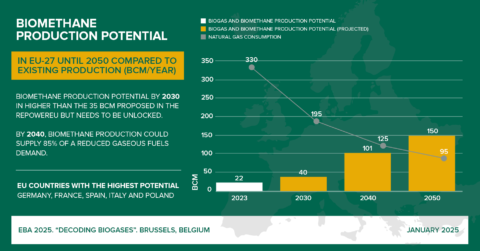
Biomethane is more than just a renewable energy source—it is a key factor in securing a sustainable energy future for Europe. Its potential already exceeds the EU’s current targets, and its active implementation could significantly strengthen the region’s energy security.
Source: EBA 2025. “Decoding Biogases.” Brussels, Belgium, January 2025.