Climate change and the transition to clean energy sources are challenging humanity to find effective and sustainable alternatives to fossil fuels. Biogas is one of the key solutions that not only contributes to energy independence, but also ensures efficient waste management and the creation of green jobs.
How is biogas produced?
The biogas production process takes place in an anaerobic digester where microorganisms decompose organic matter to form a mixture of gases, the main component of which is methane (CH₄). Purified biogas, known as biomethane, has a chemical composition identical to natural gas. This means that it can be used in existing gas transportation and distribution infrastructure, completely replacing fossil fuels.
Biogas has a significant impact on the socio-economic sphere:
- Energy security. The use of biomethane helps to reduce dependence on imported natural gas.
- Sustainable development. Biogas plants contribute to the processing of organic waste, reducing its negative impact on the environment.
- Economic growth. The development of biogas technologies contributes to the creation of new jobs in the renewable energy sector.
Biogas in numbers
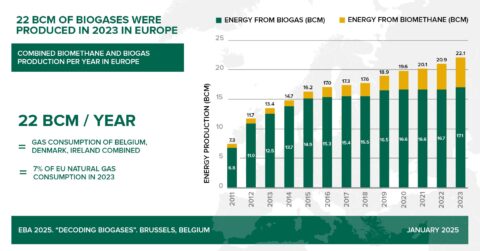
According to the European Biogas Association (EBA), the total production of biogas and biomethane in Europe reaches 22 billion cubic meters per year. This is equivalent to the annual gas consumption of Belgium, Denmark and Ireland combined, or 7% of total EU natural gas consumption in 2023.
Biogas is not only an environmentally friendly solution, but also a strategic tool for energy independence and economic development. By investing in biogas technologies, we are moving closer to a sustainable future where energy is produced without harming the environment.
Source: EBA 2025. “Decoding Biogases”. Brussels, Belgium, January 2025.